
⚙ Settings
GPA Calculator Guide: How to Calculate GPA, Cumulative GPA & Weighted GPA Easily
📌 Article Outline (Structured Hierarchy)
- H1: GPA Calculator Guide
- H2: What is GPA?
- H3: Why GPA Matters for Students
- H2: Understanding GPA Scales
- H3: 4.0 GPA Scale Explained
- H3: Weighted vs Unweighted GPA
- H2: How GPA is Calculated
- H3: GPA Formula Explained
- H3: Step-by-Step GPA Calculation
- H2: College GPA Calculator Guide
- H3: Credit Hours Importance
- H2: High School GPA Calculator
- H3: Weighted Courses Impact
- H2: Cumulative GPA Calculator
- H3: Semester vs Overall GPA
- H2: Types of GPA Calculators
- H3: Online GPA Calculators
- H3: Manual GPA Calculation
- H2: GPA from Percentage
- H2: GPA Without Credits
- H2: Improving Your GPA
- H2: Common GPA Mistakes
- H2: Conclusion
- H2: FAQs
- H2: What is GPA?
📘 What is GPA?
If you’ve ever looked at your report card and wondered, “What exactly does this number mean?”—you’re not alone. GPA (Grade Point Average) is essentially a numerical representation of your academic performance across all subjects. Think of it like your academic “scorecard” that summarizes how well you’ve been doing over time.
Instead of listing dozens of grades separately, GPA combines everything into one simple number. Schools, colleges, and even scholarship providers rely heavily on this number to evaluate students. A higher GPA often signals consistency, discipline, and strong academic skills.
Here’s something interesting: according to recent data, the average GPA for incoming college students is around 3.15, while top universities typically accept students with GPAs close to 3.9–4.0. That means even small improvements in your GPA can significantly impact your future opportunities.
Now imagine GPA like your overall “fitness score” in academics. You might do great in one subject and struggle in another, but GPA balances everything out. So instead of stressing about one bad grade, you focus on the bigger picture.
🎯 Why GPA Matters for Students
Let’s be real—GPA isn’t just a number you calculate and forget. It plays a major role in shaping your academic and professional future. Whether you’re in middle school, high school, or college, GPA acts as your academic reputation.
Colleges use GPA as one of the primary factors in admissions decisions. Scholarships often have minimum GPA requirements. Even internships and graduate programs consider it. It’s like your academic passport—it opens doors or sometimes closes them.
But here’s the twist: GPA isn’t just about intelligence. It reflects consistency. A student who regularly scores above average often has better study habits and discipline. That’s exactly what institutions are looking for.
Think of GPA as a long-term investment. Every assignment, quiz, and exam adds up. One small improvement today can lead to a massive difference later. So instead of asking, “Is GPA important?” the better question is, “How can I improve mine?”
📊 Understanding GPA Scales
Before you calculate your GPA, you need to understand the scale behind it. Without this, it’s like trying to measure distance without knowing meters or miles.
📈 4.0 GPA Scale Explained
The 4.0 GPA scale is the most commonly used system worldwide. On this scale:
| Grade | GPA Value |
|---|---|
| A | 4.0 |
| B | 3.0 |
| C | 2.0 |
| D | 1.0 |
| F | 0.0 |
This system converts your grades into numbers and averages them. A perfect GPA of 4.0 usually means straight A’s across all subjects.
You can also have slight variations like A- (3.7) or B+ (3.3), depending on your school.
Here’s the key idea: GPA isn’t about percentages—it’s about standardized points. That’s why a 95% and 93% might both count as 4.0.
⚖️ Weighted vs Unweighted GPA
Now things get interesting. There are two main types of GPA:
- Unweighted GPA
- Scale: 0–4.0
- Treats all classes equally
- Weighted GPA
- Scale: up to 5.0
- Gives extra points for harder courses like AP or Honors
So if you take advanced classes, your GPA might go above 4.0. It’s like getting bonus points for choosing tougher challenges.
Think of it like this:
Unweighted GPA = fair comparison
Weighted GPA = rewards ambition
🧮 How GPA is Calculated
Let’s break it down in the simplest way possible.
📌 GPA Formula Explained
The formula for GPA is:
GPA = (Total Grade Points × Credit Hours) ÷ Total Credit Hours
This might look complicated at first, but it’s actually very logical.
Each subject has:
- A grade value (like A = 4.0)
- A credit hour (importance of the subject)
Multiply them, add everything, then divide by total credits.
📝 Step-by-Step GPA Calculation
Let’s say you have:
- Math: A (4.0) → 3 credits
- English: B (3.0) → 4 credits
- Science: B+ (3.3) → 3 credits
Now calculate:
- Math = 4.0 × 3 = 12
- English = 3.0 × 4 = 12
- Science = 3.3 × 3 = 9.9
Total = 33.9
Divide by total credits (10):
👉 GPA = 3.39
Simple, right?
🎓 College GPA Calculator Guide
College GPA works slightly differently compared to high school. The biggest difference? Credit hours matter more.
📚 Credit Hours Importance
In college, not all courses are equal. Some subjects carry more credits, meaning they impact your GPA more.
For example:
- A 4-credit course affects GPA more than a 2-credit course
So if you fail a high-credit course, your GPA drops significantly.
Think of credit hours like “weight.” The heavier the course, the more it pulls your GPA up or down.
🏫 High School GPA Calculator
High school GPA is usually simpler—but can include weighted systems.
📊 Weighted Courses Impact
If you take:
- AP classes → +1.0 GPA boost
- Honors classes → +0.5 boost
This means:
- A in regular class = 4.0
- A in AP class = 5.0
So students taking harder subjects can achieve higher GPAs.
📈 Cumulative GPA Calculator
Your cumulative GPA is your overall GPA across all semesters.
📅 Semester vs Overall GPA
- Semester GPA = performance in one term
- Cumulative GPA = average of all semesters
It’s like comparing a single episode vs the whole series.
If you improve over time, your cumulative GPA rises gradually.
🧠 Types of GPA Calculators
🌐 Online GPA Calculators
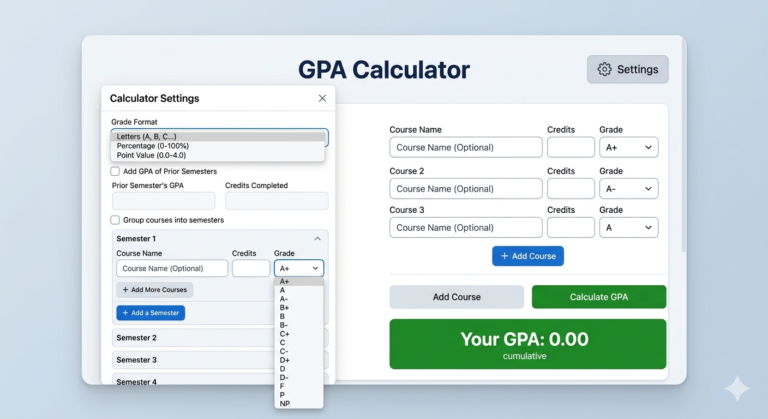
These tools are super convenient. You just enter your grades and credits, and they calculate everything instantly.
Popular features:
- Weighted/unweighted options
- Percentage conversion
- Cumulative GPA tracking
✍️ Manual GPA Calculation
Doing it manually helps you understand the system better.
It also ensures accuracy if your school uses a unique grading scale.
📊 GPA from Percentage
If your grades are in percentages:
- 90–100% = 4.0
- 80–89% = 3.0
- 70–79% = 2.0
This conversion makes GPA universal.
❓ GPA Without Credits
Some schools don’t use credit hours.
In that case:
- Add all grade points
- Divide by number of subjects
Simple average = GPA
🚀 Improving Your GPA
Improving GPA isn’t about studying harder—it’s about studying smarter.
Focus on:
- High-weight assignments
- Consistency
- Active learning techniques
Even small improvements can boost your GPA over time.
⚠️ Common GPA Mistakes
Avoid these:
- Ignoring credit hours
- Mixing weighted and unweighted scales
- Incorrect grade conversion
These mistakes can lead to wrong GPA calculations.
🏁 Conclusion
GPA might seem like just a number, but it tells a powerful story about your academic journey. Whether you’re using a college GPA calculator, high school GPA calculator, or calculating manually, understanding the system gives you full control over your academic future.
Once you know how GPA works, you stop guessing and start planning. You can predict your results, set goals, and improve strategically.
At the end of the day, GPA isn’t about perfection—it’s about progress.
❓ FAQs
1. How do I calculate my GPA easily?
Use the formula: multiply grade points by credits, add them, then divide by total credits.
2. What is a good GPA?
A GPA above 3.0 is average, while 3.5+ is considered strong.
3. Can GPA go above 4.0?
Yes, in weighted GPA systems (up to 5.0).
4. How is cumulative GPA calculated?
By averaging all semester GPAs over time.
5. Are online GPA calculators accurate?
Yes, if you input correct grades and credits.