
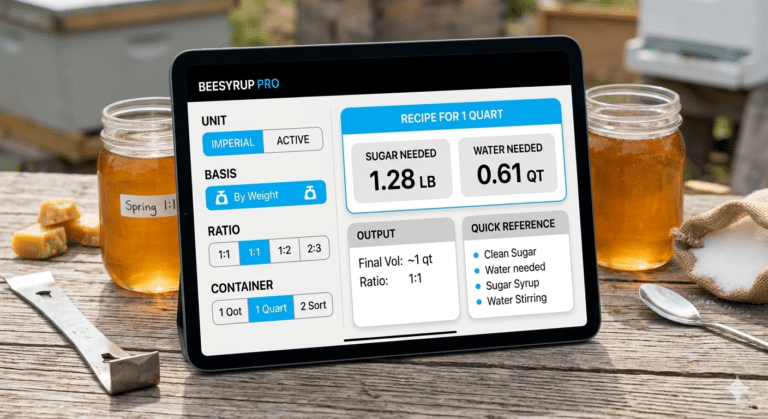
Sugar Syrup Calculator
Mixing basis
Weight-based is more accurate.
Syrup Ratio
1:1 is thinner syrup, commonly used in spring to stimulate brood production.
Container to Fill
1 Quart = 1 qt
Recipe for 1 Quart
Output
Quick Reference
To fill 1 Quart with 1:1 syrup:
- Measure 0.61 qt of water
- Heat until warm (not boiling)
- Add 1.28 lb of sugar
- Stir until dissolved, let cool
Mixing Tips
Mixing Instructions:
- Measure your water and heat until warm (not boiling).
- Slowly add sugar while stirring continuously.
- Stir until all sugar is completely dissolved.
- Allow to cool before feeding to bees.
- Store unused syrup in a sealed container.
Professional Sugar Syrup Calculator: Perfect 1:1 and 2:1 Ratios
Whether you are a dedicated apiarist tending to your hives or a culinary enthusiast perfecting a new recipe, precision is the key to success. In the world of beekeeping, the difference between a thriving colony and a struggling one often comes down to supplemental feeding. This is where a professional sugar syrup calculator becomes an indispensable tool.
In this guide, we will explore the science behind syrup concentrations, when to use a 1:1 sugar syrup calculator versus a 2:1 sugar syrup calculator, and how to ensure your measurements are perfect every time.
Why Do You Need a Sugar Syrup Calculator?
At its core, sugar syrup is a simple solution of granulated white sugar and water. However, the density of this solution changes its purpose. Measuring by “eye” or using inconsistent containers can lead to ratios that are either too thin to be useful or too thick to dissolve properly.
Using a bee sugar syrup calculator ensures:
Consistency: Your bees receive the exact caloric intake they need for the specific season.
Cost-Efficiency: You don’t waste expensive sugar by overestimating the amount needed for your containers.
Health: Properly mixed syrup prevents fermentation and digestive issues in bees.
Understanding the Ratios: 1:1 vs. 2:1
1. Spring Feeding: The 1:1 Ratio
Spring is a time of growth. As the weather warms up, beekeepers want to encourage the Queen to start laying eggs to build up the colony’s population.
A 1:1 sugar syrup calculator (often searched as a 1 1 sugar syrup calculator) helps you create a “thin” syrup. This mimics the consistency of natural flower nectar.
The Purpose: It stimulates brood rearing and encourages the bees to draw out new wax foundation.
The Mix: Equal parts sugar and water by weight. For example, 10 lbs of sugar mixed with 10 lbs (about 1.2 gallons) of water.
2. Autumn/Winter Feeding: The 2:1 Ratio
As winter approaches, the goal shifts from growth to storage. Bees need a “heavy” syrup that they can store in the comb for winter cluster heat.
Using a 2:1 sugar syrup calculator is vital during this time.
The Purpose: Since this syrup is much thicker, the bees have to work less to evaporate the moisture before capping it as “winter stores.”
The Mix: Two parts sugar to one part water. Because this is a high-saturation mix, using a beekeeping sugar syrup calculator is helpful to determine if you need to heat the water to get the sugar to dissolve completely.
Beyond Beekeeping: The Sugar to Maple Syrup Conversion
In the culinary world and sometimes in organic beekeeping experiments, people look for alternatives to white table sugar. This often leads to the search for a sugar to maple syrup calculator or a sugar to maple syrup conversion calculator.
Maple syrup is not just sugar; it is roughly 66% sugar and 34% water. If you are substituting one for the other, you cannot use a simple 1:1 swap.
To replace 1 cup of white sugar, you typically use 1 cup of maple syrup but must decrease the other liquids in your recipe by about 3 tablespoons.
A specialized sugar to maple syrup calculator helps you maintain the “Brix” level of your solution so the sweetness remains constant.
The Science of Sweetness: Brix and Density
For those who want to be highly technical, we look at the Brix scale. But how to calculate brix of sugar syrup without expensive laboratory equipment?
Brix represents the percentage of sugar by weight in a liquid solution.
A 1:1 ratio is approximately 50 Brix (50% sugar).
A 2:1 ratio is approximately 66.7 Brix (66.7% sugar).
Using a sugar syrup brix calculator is essential for commercial food production and advanced beekeeping. If the Brix is too low, the syrup will ferment and grow mold. If it is too high (above 70), the sugar will recrystallize and become inaccessible to the bees.
Step-by-Step: How to Mix Perfect Syrup
Once you have used your sugar syrup calculator to get your measurements, follow these steps:
Step 1: Measure by Weight
While volume (cups/quarts) is easy, weight is more accurate. A gallon of sugar does not weigh the same as a gallon of water. Professional beekeeping sugar syrup calculators almost always prioritize weight for this reason.
Step 2: Heat the Water
For a 1:1 mix, room temperature water is often enough. For a 2:1 mix, you will need to heat the water. Crucial Tip: Do not boil the syrup. Overheating sugar can create Hydroxymethylfurfural (HMF), which is toxic to honeybees. Heat the water, turn off the flame, and then stir in the sugar.
Step 3: Stir until Clear
The syrup should be clear, not cloudy. Cloudy syrup indicates undissolved crystals, which will settle at the bottom of your feeder.
Step 4: Cool and Feed
Never provide hot syrup to bees. Let it reach room temperature before placing it in the hive.
Common Questions (FAQ)
Q: Can I use brown sugar or molasses? A: No. For beekeeping, only use white granulated sugar. Brown sugar and molasses contain solids and impurities that can cause fatal dysentery in bees.
Q: How long does sugar syrup last? A: Thin syrup (1:1) can spoil in 3-5 days in warm weather. Heavy syrup (2:1) lasts longer due to the higher sugar concentration, but you should always check for a “vinegar” smell or black mold.
Q: What is the best tool for checking concentration? A: While a sugar syrup brix calculator gives you the theory, a handheld Refractometer is the best tool to check the actual Brix of your final mix.
Conclusion
Precision matters. Whether you are using a 1:1 sugar syrup calculator to kickstart your spring colony or a sugar syrup brix calculator to ensure your commercial preserve is shelf-stable, the math remains the foundation.
By utilizing a dedicated beekeeping sugar syrup calculator, you remove the guesswork, save money on supplies, and most importantly, provide the best possible care for your bees. Bookmark our sugar syrup calculator today and take the complexity out of your mixing routine!