
Prime Number Calculator
Check, find, factorize, and explore prime numbers
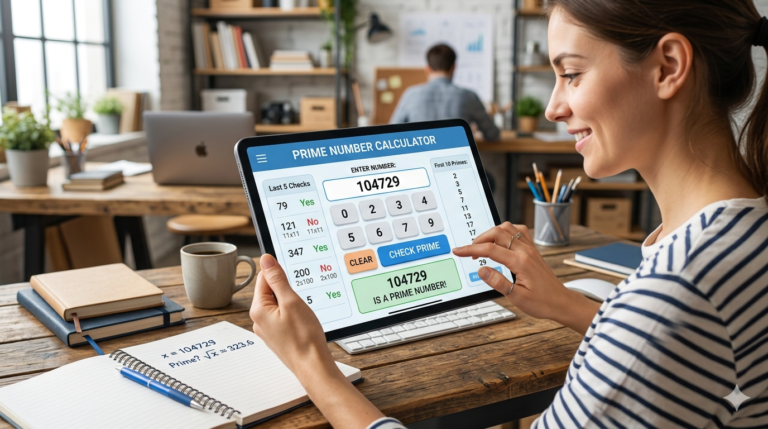
Prime Number Calculator: The Ultimate Guide to Calculating, Checking, and Factoring Primes
📌 Article Outline
- H1: Prime Number Calculator: Complete Guide
- H2: What is a Prime Number?
- H3: Definition and Basic Concept
- H3: Examples of Prime and Composite Numbers
- H2: Why Prime Numbers Matter
- H3: Role in Mathematics
- H3: Importance in Cryptography
- H2: Prime Number Calculator Explained
- H3: What Does a Prime Calculator Do?
- H3: Types of Prime Calculators
- H2: How to Check if a Number is Prime
- H3: Basic Division Method
- H4: Step-by-Step Example
- H2: Prime Number Calculation Formula
- H3: Trial Division Formula
- H3: Advanced Mathematical Approaches
- H2: Prime Factorization Explained
- H3: What is Prime Factorization
- H3: Manual Calculation Method
- H2: Prime Factorization Calculator
- H3: How It Works
- H3: Large Number Factorization
- H2: Prime vs Composite Number Calculator
- H3: Key Differences
- H3: How Tools Identify Them
- H2: Algorithms for Prime Number Calculation
- H3: Trial Division Algorithm
- H3: Sieve of Eratosthenes
- H2: Programming Prime Number Calculators
- H3: Python Code Example
- H3: JavaScript and C++ Examples
- H2: Advanced Calculators
- H3: Next Prime Number Calculator
- H3: Nth Prime Number Calculator
- H2: Real-World Applications
- H3: Encryption & Security
- H3: Data Science & Computing
- H2: Common Mistakes When Calculating Primes
- H2: Best Practices for Fast Calculation
- H2: Conclusion
- H2: FAQs
- H2: What is a Prime Number?
Prime Number Calculator: Complete Guide
What is a Prime Number?
Definition and Basic Concept
A prime number is one of those mathematical gems that seems simple at first glance but hides surprising depth. In the simplest terms, a prime number is a natural number greater than 1 that has only two factors: 1 and itself. That’s it—no shortcuts, no extra divisors sneaking in. Think of it like a locked door with only two keys. If more keys exist, it’s no longer prime.
When you first encounter prime numbers, they might feel like just another math topic. But here’s the twist: they form the foundation of many advanced systems, from encryption to algorithms. Without primes, modern computing would look very different.
Examples of Prime and Composite Numbers
Let’s make this more practical. Numbers like 2, 3, 5, 7, 11, and 13 are prime because nothing divides them evenly except 1 and themselves. On the flip side, numbers like 4, 6, 8, and 9 are called composite numbers because they have more than two factors.
Take 9, for example. You might think it’s prime at first glance, but it’s divisible by 3 as well. That one extra divisor changes everything. Understanding this difference is the first step toward using any prime number calculator effectively.
Why Prime Numbers Matter
Role in Mathematics
Prime numbers are often referred to as the building blocks of numbers, and for good reason. Every composite number can be broken down into prime factors. This concept, known as prime factorization, is like breaking a number into its smallest meaningful parts.
Mathematicians have studied primes for centuries, and they still haven’t uncovered all their secrets. Patterns in prime numbers are unpredictable, which makes them both fascinating and challenging to analyze.
Importance in Cryptography
Now here’s where things get exciting. Prime numbers are at the heart of modern encryption systems. Whenever you send a secure message, make an online payment, or log into a website, prime numbers are working behind the scenes.
Encryption methods like RSA rely on the difficulty of factoring large prime numbers. This means that even with powerful computers, cracking the code would take an impractical amount of time. That’s why large prime number calculators are so valuable—they help generate numbers strong enough for security systems.
Prime Number Calculator Explained
What Does a Prime Calculator Do?
A prime number calculator is a tool designed to make your life easier. Instead of manually checking divisibility, the calculator instantly tells you whether a number is prime or composite.
Some calculators go beyond basic checks. They can:
- Find the next prime number
- Calculate the nth prime
- Perform prime factorization
- Identify co-prime numbers
These tools save time and reduce errors, especially when working with large numbers.
Types of Prime Calculators
There are several types of calculators available depending on your needs:
- Prime or Composite Number Calculator
- Prime Factorization Calculator
- Next Prime Number Calculator
- Nth Prime Number Calculator
Each serves a specific purpose, and choosing the right one depends on what you’re trying to achieve.
How to Check if a Number is Prime
Basic Division Method
The simplest way to check if a number is prime is by using the trial division method. You divide the number by all integers starting from 2 up to the square root of that number.
If none of those divisions result in a whole number, then congratulations—you’ve got a prime!
Step-by-Step Example
Let’s say you want to check if 29 is prime.
- Find the square root of 29 (approximately 5.38)
- Test divisibility by numbers less than or equal to 5
- Check 2, 3, 4, and 5
Since none divide 29 evenly, it’s a prime number.
This method works well for small numbers, but it becomes inefficient for larger ones—which is where calculators come in handy.
Prime Number Calculation Formula
Trial Division Formula
There isn’t a single “magic formula” for primes, but the trial division method can be expressed mathematically. You test whether a number n is divisible by any integer i such that:
- 2 ≤ i ≤ √n
If no such divisor exists, the number is prime.
Advanced Mathematical Approaches
For larger numbers, mathematicians use more advanced techniques like:
- Fermat’s Little Theorem
- Miller-Rabin Primality Test
These methods are faster and more efficient, especially when dealing with numbers that have hundreds of digits.
Prime Factorization Explained
What is Prime Factorization
Prime factorization is the process of breaking a number down into its prime components. For example:
- 28 = 2 × 2 × 7
Each factor here is a prime number. This decomposition is unique for every number, making it incredibly useful in mathematics.
Manual Calculation Method
To factor a number manually:
- Divide by the smallest prime (2)
- Continue dividing until you can’t anymore
- Move to the next prime number
Repeat until you’re left with 1.
Prime Factorization Calculator
How It Works
A prime factorization calculator automates this process. You input a number, and it instantly returns its prime factors. This is especially useful when dealing with large numbers that would take too long to factor manually.
Large Number Factorization
Factoring large numbers is computationally intensive. Some calculators are designed specifically for big prime number calculations, handling numbers with 100+ digits.
Prime vs Composite Number Calculator
Key Differences
- Prime Numbers: Only 2 factors
- Composite Numbers: More than 2 factors
How Tools Identify Them
Calculators use algorithms to quickly determine whether a number has additional divisors. If it does, it’s composite; if not, it’s prime.
Algorithms for Prime Number Calculation
Trial Division Algorithm
This is the most basic algorithm. It’s easy to understand but not efficient for large numbers.
Sieve of Eratosthenes
This algorithm is much faster for generating a list of primes up to a certain number. It works by eliminating multiples of primes step by step.
Programming Prime Number Calculators
Python Code Example
Here’s a simple Python function:
def is_prime(n):
    if n <= 1:
        return False
    for i in range(2, int(n**0.5) + 1):
        if n % i == 0:
            return False
    return True
This code checks whether a number is prime efficiently.
JavaScript and C++ Examples
In JavaScript:
function isPrime(n) {
  if (n <= 1) return false;
  for (let i = 2; i <= Math.sqrt(n); i++) {
    if (n % i === 0) return false;
  }
  return true;
}
In C++:
bool isPrime(int n) {
    if (n <= 1) return false;
    for(int i = 2; i <= sqrt(n); i++) {
        if(n % i == 0) return false;
    }
    return true;
}
Advanced Calculators
Next Prime Number Calculator
This tool finds the next prime after a given number. It’s useful when generating sequences or working with algorithms.
Nth Prime Number Calculator
Want to know the 100th or 1000th prime? This calculator does exactly that using optimized algorithms.
Real-World Applications
Encryption & Security
Prime numbers are essential for securing digital communication. Without them, online privacy would be nearly impossible.
Data Science & Computing
They’re also used in hashing algorithms, random number generation, and more.
Common Mistakes When Calculating Primes
People often:
- Forget that 1 is not prime
- Skip checking divisibility properly
- Assume large numbers are always composite
Avoiding these mistakes is key to accurate calculations.
Best Practices for Fast Calculation
- Use square root optimization
- Apply efficient algorithms
- Use calculators for large numbers
Conclusion
Prime numbers might seem like a simple concept at first, but they play a massive role in both mathematics and technology. From basic calculations to advanced encryption systems, they are everywhere. Whether you’re using a prime number calculator, writing code, or solving math problems, understanding how primes work gives you a powerful advantage.
FAQs
1. What is the fastest way to check if a number is prime?
Using the square root method or a prime calculator is the fastest for most cases.
2. Can large numbers be prime?
Yes, there are primes with hundreds of digits used in cryptography.
3. What is a co-prime number?
Two numbers are co-prime if their greatest common divisor is 1.
4. Is 1 a prime number?
No, because it has only one factor.
5. Which programming language is best for prime calculations?
Python is popular due to simplicity, but C++ is faster for large computations.