
Garnet Health BMR Calculator
Basal Metabolic Rate & Daily Calorie Needs
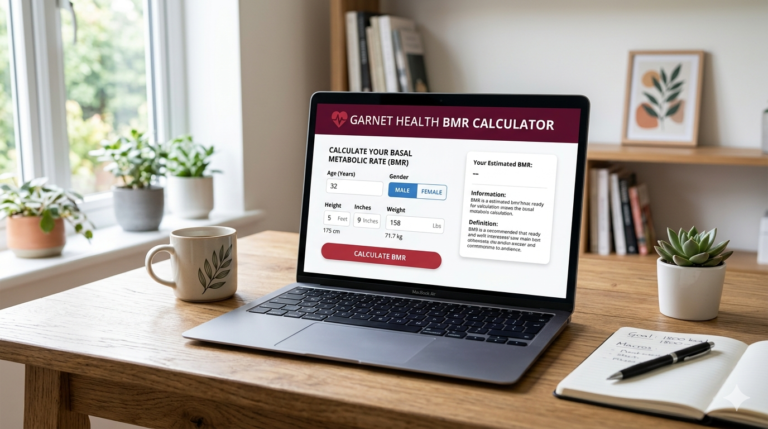
Garnet Health BMR Calculator: The Complete Guide to Understanding Your Metabolism and Calories
Article Outline
- H1: Garnet Health BMR Calculator: Complete Guide
- H2: What is BMR (Basal Metabolic Rate)?
- H3: Why Your Body Needs Energy at Rest
- H3: Difference Between BMR and RMR
- H2: Overview of Garnet Health BMR Calculator
- H3: How the Tool Works
- H3: Who Should Use It
- H2: BMR Formula Used by Garnet Health
- H3: BMR Formula for Men
- H3: BMR Formula for Women
- H2: Key Factors That Affect Your BMR
- H3: Age and Metabolism
- H3: Weight, Height, and Gender
- H3: Muscle Mass and Lifestyle
- H2: How to Calculate Your BMR Step-by-Step
- H3: Required Inputs Explained
- H3: Example Calculation
- H2: Why Knowing Your BMR is Important
- H3: Weight Loss Planning
- H3: Muscle Gain and Fitness Goals
- H2: BMR vs TDEE: What’s the Difference?
- H3: Understanding Daily Calorie Needs
- H2: Benefits of Using Garnet Health Calculator
- H3: Accuracy and Simplicity
- H2: Limitations of BMR Calculators
- H3: Why Results Are Estimates
- H2: Tips to Improve Your Metabolism Naturally
- H3: Exercise and Muscle Building
- H3: Diet and Nutrition Habits
- H2: What is BMR (Basal Metabolic Rate)?
What is BMR (Basal Metabolic Rate)?
Why Your Body Needs Energy at Rest
Let’s start with something fascinating—your body is constantly burning calories, even when you’re doing absolutely nothing. Sounds surprising, right? That’s where Basal Metabolic Rate (BMR) comes in. It represents the number of calories your body needs just to stay alive—yes, even if you stayed in bed all day doing nothing.
According to recent health data, BMR accounts for about 60–70% of the calories your body burns daily, which makes it the largest chunk of your energy usage. Think about it like your phone running background apps—it’s still consuming battery even when you’re not actively using it. Your body does the same thing for essential functions like breathing, blood circulation, and maintaining body temperature.
Experts define BMR as the minimum energy needed for survival functions such as respiration, cell production, and nutrient processing. That means every heartbeat, every breath, and every cell repair process is powered by this baseline energy requirement.
Now imagine trying to lose weight or build muscle without knowing this number—it’s like driving a car without knowing how much fuel you have. That’s why tools like the Garnet Health BMR Calculator are so valuable. They give you a starting point to understand your body’s energy needs, helping you make smarter decisions about diet and fitness.
Difference Between BMR and RMR
Many people confuse BMR with something called Resting Metabolic Rate (RMR), but they’re not exactly the same. While both measure energy burned at rest, BMR is more strict—it assumes a completely inactive state, like being asleep in a controlled environment.
RMR, on the other hand, includes slight daily activities like sitting, standing, or even digesting food. In simple terms, BMR is the pure baseline, while RMR is a slightly more realistic version of daily rest energy.
Understanding this difference helps you interpret calculator results better. When you use the Garnet Health BMR Calculator, you’re getting a clean, foundational number—the lowest amount of energy your body needs to function.
Overview of Garnet Health BMR Calculator
How the Tool Works
The Garnet Health BMR Calculator is a simple yet powerful online tool designed to estimate your metabolic rate. You input basic details like your age, height, weight, and gender—and within seconds, it calculates your BMR.
The calculator uses a widely accepted formula to estimate how many calories your body burns daily at rest. This eliminates guesswork and gives you a scientific baseline to plan your health goals.
What makes it appealing is its simplicity. You don’t need medical knowledge or complex math skills. Just enter your data, and the tool does the rest. It’s like having a mini nutritionist in your pocket.
Who Should Use It
This calculator isn’t just for fitness enthusiasts or athletes—it’s for everyone. Whether you’re trying to lose weight, gain muscle, or simply understand your body better, knowing your BMR is incredibly useful.
- Beginners starting their fitness journey
- People tracking calorie intake
- Athletes optimizing performance
- Anyone curious about metabolism
If you’ve ever wondered, “How many calories do I actually need?”—this tool is your answer.
BMR Formula Used by Garnet Health
BMR Formula for Men
The Garnet Health calculator uses the Harris-Benedict Equation, a classic and widely trusted formula:
- Men:
BMR = 88.362 + (13.397 × weight in kg) + (4.799 × height in cm) − (5.677 × age)
This formula considers body size and age, giving a personalized estimate rather than a generic number.
BMR Formula for Women
For women, the formula is slightly different:
- Women:
BMR = 447.593 + (9.247 × weight in kg) + (3.098 × height in cm) − (4.330 × age)
These formulas highlight an important point—metabolism is not one-size-fits-all. Gender differences, body composition, and hormonal factors all influence calorie needs.
Key Factors That Affect Your BMR
Age and Metabolism
Ever noticed how it becomes harder to lose weight as you get older? That’s because your BMR naturally decreases with age. Studies show metabolism slows gradually over time, meaning your body requires fewer calories.
Weight, Height, and Gender
Larger bodies need more energy to function. So if you’re taller or weigh more, your BMR will likely be higher. Men typically have a higher BMR than women due to greater muscle mass.
Muscle Mass and Lifestyle
Muscle burns more calories than fat—even at rest. That means someone with more muscle mass will have a higher BMR. Regular exercise, especially strength training, can significantly boost your metabolism.
How to Calculate Your BMR Step-by-Step
Required Inputs Explained
To calculate your BMR, you need:
- Age
- Weight (kg)
- Height (cm)
- Gender
These inputs allow the calculator to estimate your resting calorie needs accurately.
Example Calculation
Let’s say:
- Age: 25
- Weight: 70 kg
- Height: 175 cm
Using the formula, your BMR would be roughly around 1,700–1,800 calories/day. That means your body needs this amount just to function without any activity.
Why Knowing Your BMR is Important
Weight Loss Planning
If you want to lose weight, you need to consume fewer calories than your total daily energy expenditure. Your BMR acts as the foundation for calculating that number.
Muscle Gain and Fitness Goals
Trying to build muscle? Then you’ll need to eat more than your BMR plus activity calories. Without knowing your baseline, you’re basically guessing.
BMR vs TDEE: What’s the Difference?
Understanding Daily Calorie Needs
BMR is just the starting point. To find your Total Daily Energy Expenditure (TDEE), you add calories burned through activity.
Think of it like this:
| Metric | Meaning |
|---|---|
| BMR | Calories burned at rest |
| TDEE | Total calories burned daily |
Your real calorie needs depend on TDEE, not just BMR.
Benefits of Using Garnet Health Calculator
Accuracy and Simplicity
The biggest advantage is ease of use. It provides quick estimates without requiring advanced knowledge. Plus, it’s based on trusted formulas used in healthcare.
Limitations of BMR Calculators
Why Results Are Estimates
No calculator is 100% accurate. Factors like genetics, hormones, and health conditions can affect metabolism. That’s why BMR should be used as a guideline, not an absolute number.
Tips to Improve Your Metabolism Naturally
Exercise and Muscle Building
Strength training is one of the best ways to increase BMR. More muscle equals more calories burned—even at rest.
Diet and Nutrition Habits
Eating enough protein, staying hydrated, and avoiding extreme dieting can help maintain a healthy metabolism.
Conclusion
Understanding your body starts with knowing your numbers—and BMR is the most important number of all. The Garnet Health BMR Calculator gives you a clear, science-backed estimate of how many calories your body needs to survive.
Once you know your BMR, everything else becomes easier—whether it’s losing weight, gaining muscle, or simply staying healthy. Instead of guessing, you’re making informed decisions. And that’s the difference between struggling and succeeding in your fitness journey.
FAQs
1. Is the Garnet Health BMR Calculator accurate?
It provides a reliable estimate using established formulas, but it may not be 100% precise due to individual variations.
2. Can I lose weight using only my BMR?
No, you need to consider your total daily energy expenditure (TDEE) for effective weight loss.
3. How often should I calculate my BMR?
Every few months or after significant weight changes to keep your data updated.
4. Does exercise increase BMR?
Yes, especially strength training, which increases muscle mass and boosts metabolism.
5. What is a normal BMR range?
It varies widely depending on age, gender, and body composition—there’s no single “normal” number.